▶ Every era of software was unlocked by a language made for it

Weft is the foundation for AI systems

Made for what will kill AI agents

The first programming language designed for AI to write. Tangle, the coding assistant built into Weft, writes it for you, and you read it as a graph.

Free and open source. Runs on your machine. Come say hi on Discord

Early, but it runs most projects. Cloud deploy works on GCP today.

Not ready? Follow the build

No spam. Occasional updates on what I ship and what is coming.

Our founder red-teamed AI since davinci for

OpenAI
Anthropic
METR
Amazon AGI

▶ Meet Tangle

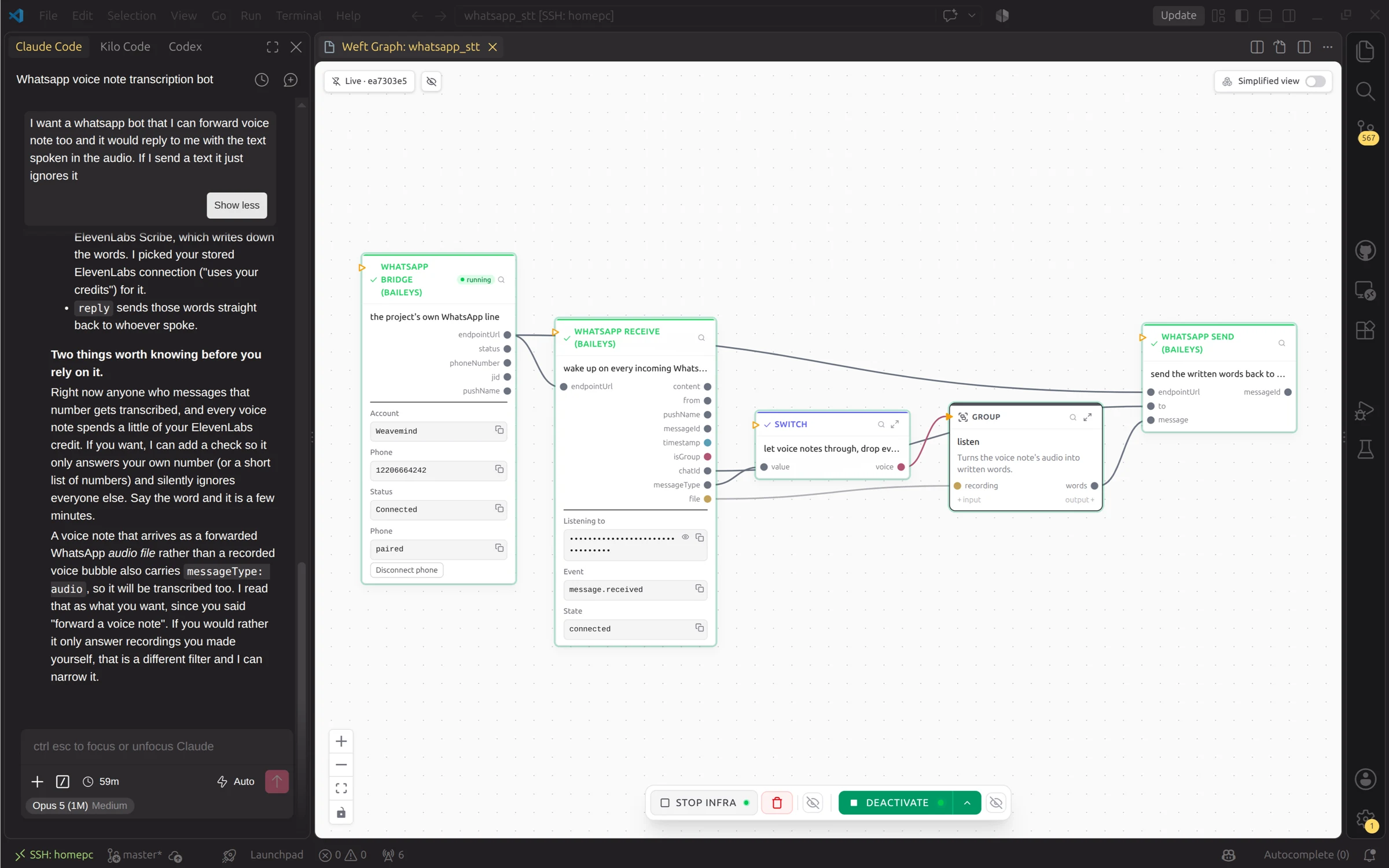
You never have to learn this language. Tangle is Weft's built-in coding assistant, and it runs inside the one you already use. You tell it what you want in plain words, and it builds the whole thing.

Tangle in Claude Code: the request for a WhatsApp voice-note bot on the left, the program it built on the right, running

On the left, a real request for a WhatsApp bot that turns your voice notes into text. On the right, the program Tangle built for it, already running.

From an idea to a deployed product, without you steering each step.

30min

for Tangle to build, often from a single prompt, a program the best AI models take tens of hours to write on their own.

  1. 01

    Tells you the plan first

    In a sentence or two it tells you which steps the program will have, and if there is a real choice to make, it asks you before building.

  2. 02

    Writes expert prompts and missing pieces

    Every prompt in your program is written by a helper built on years of prompt-engineering work. If no building block does what you need, another helper writes one.

  3. 03

    Tests every piece

    Before it hands you the program, every piece has already run, on made-up values or on a real input you gave it, and anything that came out wrong has been fixed and run again.

  4. 04

    Fixes a case and keeps it fixed

    Hand it a case that has to work, like one that failed in production. Tangle works on the program until that case comes out right, then freezes that run, so any later run of the case shows exactly what changed.

  5. 05

    Builds the frontend

    Ask for a site or an app, and it builds one that talks to your program.

  6. 06

    Deploys it

    It puts the program on your own cloud, so it keeps running when your laptop is closed.

Works with

Claude Code Cline Codex Cursor Devin Desktop Gemini CLI GitHub Copilot Junie Kilo Code OpenCode

▶ Try it

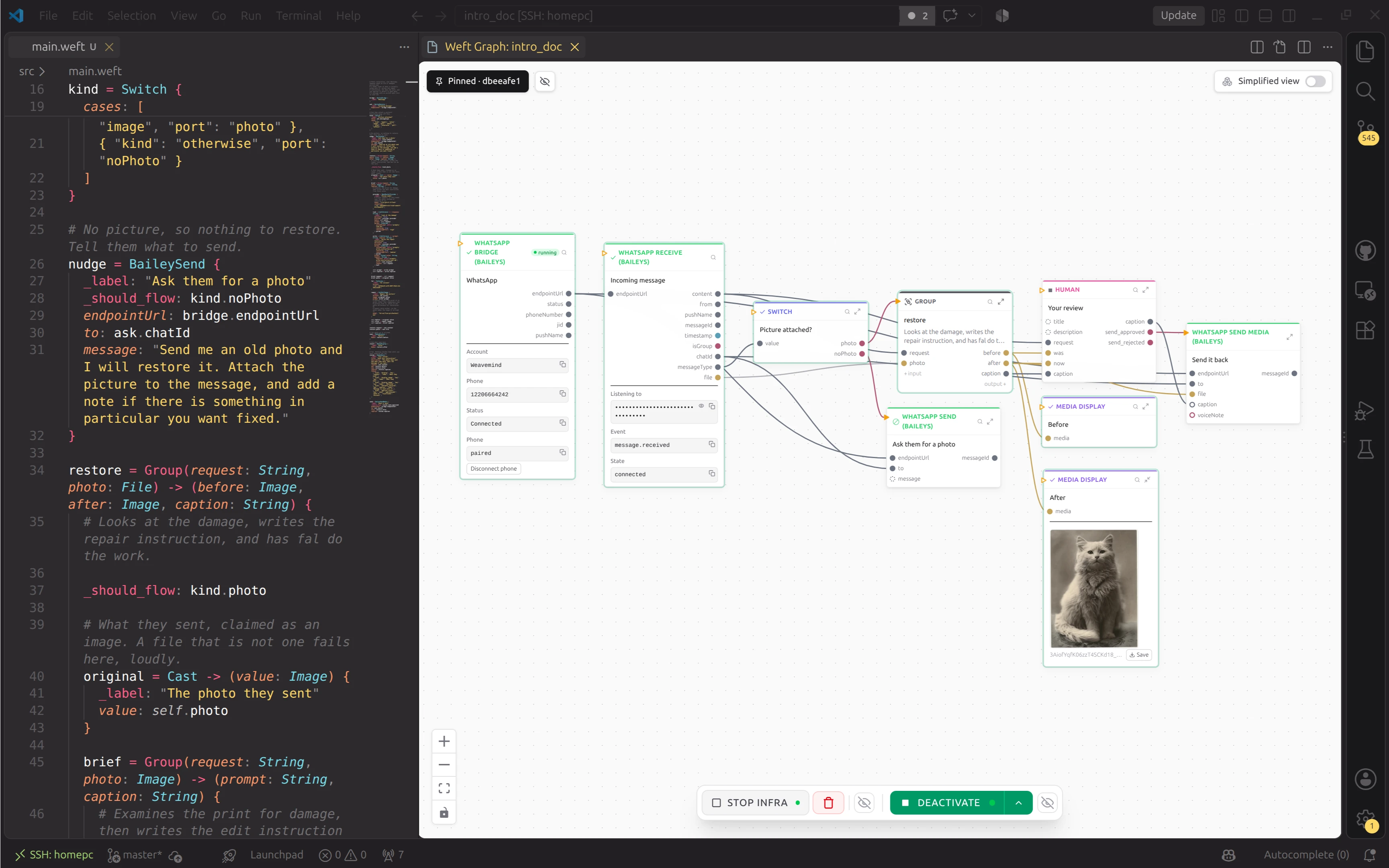
This is Weft. Our AI (Tangle) wrote the code, the graph is for you: one program, two views, always in sync.

A Weft program shown as code and as a graph, side by side in VS Code

Install Weft to click around in yours.

▶ Scoped runs

Run any piece of the program on its own. Every node and every group is a boundary. Pick one, start there, stop wherever you want.

01

Start from any input

Feed it made-up values, a real input you saved, or the real services you connected. The rest of the program comes from the last run instead of running again.

02

Freeze the cases that matter

Say a real case fails in production. Save it, work on the program until it comes out right, then freeze that run as the right answer for the case. After any later change, run it again and see exactly what moved on the wires.

03

The loop Tangle runs

This is why Tangle can test alone: it runs a piece, reads the result, fixes the step, and runs it again. You come back to a program that has already been run on real input.

weft · zsh
$weft run --from classify='{"text":"the invoice is wrong"}' --save invoice --target reply
✓classify → billing
✓reply → "Sorry for the trouble…"
Tangle reads reply: it apologises and never mentions the invoice. It rewrites the prompt.
$weft run --seed --target reply
↻classify reused from the last run
✓reply names the invoice, offers a fix
$weft freeze invoice --expect reply
✓froze examples/invoice.json from run 7c41e2 (6 wires, 0 answers)

▶ Why orchestration

Orchestration beats agents, every time. An agent makes one model do the whole job in one context. Break it into scoped steps, the right computation at each one, and you win four ways.

01 · Who decides what happens

Reliable

An agent has to hold the whole job together by itself. Here the program holds it, so a long job no longer depends on one model keeping track of everything.

An agent decides as it goesYou set the structure up frontstart???classifychecksend

02 · How good the work is

Smarter

Scoped to its job, the model isn’t distracted by everything else the task touched, so it does it better.

One agent juggling everything

the goalevery toolall the historyevery edge case

Each step handed just its part

classify the message
look up the order number
reply the order and the question

03 · How long it takes

Faster

An agent is one worker going step by step. A graph runs the pieces side by side, with no single bottleneck.

0s30s60s90s
An agent · one at a time90s
search the web
read the CRM
scan the inbox
check the calendar
A graph · all at once24s
search the web
read the CRM
scan the inbox
check the calendar

04 · What it costs

Cheaper

An agent re-reads the whole conversation every time it acts, and you pay for it each time. Each step here pays once.

An agent47k tokens

each call re-reads the whole conversation

A graph9k tokens

each step reads only its own input

▶ Flexibility

Every step can be as strict as code, or as free as a full agent. In between, it can be an agent that only gets the tools you hand it.

An orchestration can hold agents too: a step can be as open-ended as you want. The difference is that you decide the degree of freedom per step, like a contract. A bare agent is just the one extreme: a single step with the dial maxed and no rules.

Orchestration · the same run, freedom set per step

classify

Locked

does one exact thing

research

Full agent

anything can happen

draft

Scoped agent

free, but only these tools

send

Locked

does one exact thing

turn the dial from pure logic, up to a full agent, anywhere in between

An agent · one step, freedom maxed everywhere

anything can happen, the whole way · you can’t see in

full freedom is the only setting, and it covers everything at once

▶ Comparison

So why isn’t everyone building orchestrations yet?

Tangle + Weft

Built for orchestration

Flexible
Scales to production
Helps you build orchestrations
No expertise required

Traditional languages

You fight the language

Flexible
Scales to production
Helps you build orchestrations
No expertise required

Visual flow builders

Locked to pre-made blocks

Flexible
Scales to production
Helps you build orchestrations
No expertise required

The agent’s one real edge was speed to start: nothing to set up, just prompt it. But Tangle builds so fast that building and running beats the agent doing it raw

Traditional code
build
AI agent
run
Tangle + Weft
build
run

build + run, end to end, beats the agent in most real cases

▶ Custom tools

Give your AI tools no one else can. An agent is only as good as its tools. Everyone ships the same generic ones. Here you build tools for your exact task, in minutes.

To the llm, buy is one tool. You built what’s inside it: tiers, approvals and a secure payment, in minutes. And it’s a graph, so you watch every step run.

shop until the order is done
LLM

pick the next action to take

Web Search

search the web for offers

Send Email

ask the supplier a question

Group

buy within the spending rules

buy within the spending rules
Switch

route the order by its amount

under €100

buy now, capped €1k/hr

€100–1k

a teammate approves

over €1k

another team signs off

HTTP Request

pay through the secure gateway

▶ Who it's for

Who this is for.

Hobbyists & small businesses

Build the things that make your life easier

A phone line that books your clients, an agent that runs your store, a research bot that never sleeps. The kind of software that used to need a team of devs: describe it and ship it the same day

Vertical-AI & enterprises

Robust systems running at scale

You bring the domain expertise. We're the backbone you build on, and we embed alongside your team. White-label it, run it on your infrastructure, audit every step

▶ Humans

When the AI needs a human, it asks. Weft has a browser extension built right in. When it needs you it pauses, for days if it has to, with nothing running and no compute to pay for while it waits, then picks up the second you’re back.

outreach · run

paused
LLM

draft the email to this lead

Human

approve or skip this lead

Send Email

send the email once it's approved

Weft tasks
Outreach review Approve or skip this lead
1 / 5

Lead

Dana Ruiz · Head of Platform Kettlewick Freight

Subject

Message

▶ Python vs Weft

The same system, in Python vs Weft. An inbox assistant: it drafts a reply to each new email, waits for you to approve or edit it, then sends it in the thread.

Pythoninbox_bot.py
not finished
import os, json, time, base64, threading, logging
from email.mime.text import MIMEText
from google.oauth2.credentials import Credentials
from google.auth.transport.requests import Request
from googleapiclient.discovery import build
from googleapiclient.errors import HttpError
import anthropic, psycopg2, psycopg2.extras
from flask import Flask, request, render_template_string, abort

SCOPES = ["https://www.googleapis.com/auth/gmail.readonly", "https://www.googleapis.com/auth/gmail.send"]
log = logging.getLogger("inbox-bot")
app = Flask(__name__)

def gmail_service():
    creds = Credentials.from_authorized_user_file("token.json", SCOPES) if os.path.exists("token.json") else None
    if not creds or not creds.valid:
        if creds and creds.expired and creds.refresh_token: creds.refresh(Request())
        else: raise RuntimeError("run the oauth flow first")  # TODO: who does this on the server?
        open("token.json", "w").write(creds.to_json())
    return build("gmail", "v1", credentials=creds, cache_discovery=False)

gmail, llm = gmail_service(), anthropic.Anthropic(api_key=os.environ["ANTHROPIC_API_KEY"])
db = psycopg2.connect(os.environ["DATABASE_URL"], cursor_factory=psycopg2.extras.RealDictCursor)

def decode_body(payload):
    if payload.get("body", {}).get("data"): return base64.urlsafe_b64decode(payload["body"]["data"]).decode("utf-8", "replace")
    for part in payload.get("parts", []) or []:
        if part.get("mimeType") == "text/plain" and part["body"].get("data"): return decode_body(part)
    for part in payload.get("parts", []) or []:
        found = decode_body(part)
        if found: return found  # html only? strip tags? attachments?
    return ""

def draft_reply(text, attempt=0):
    try:
        r = llm.messages.create(model="claude-sonnet-5-5", max_tokens=1024, messages=[{"role": "user", "content": text}])
        return "".join(b.text for b in r.content if b.type == "text")
    except (anthropic.RateLimitError, anthropic.APIConnectionError) as e:
        if attempt >= 5: raise
        time.sleep(2 ** attempt); return draft_reply(text, attempt + 1)

def poll_forever():
    seen = {r["msg_id"] for r in query("SELECT msg_id FROM reviews")}
    while True:
        try:
            res = gmail.users().messages().list(userId="me", q="label:inbox -from:me", maxResults=50).execute()
        except HttpError as e:
            log.warning("gmail list failed: %s", e); time.sleep(30); continue
        for m in res.get("messages", []):
            if m["id"] in seen: continue
            msg = gmail.users().messages().get(userId="me", id=m["id"], format="full").execute()
            headers = {h["name"].lower(): h["value"] for h in msg["payload"]["headers"]}
            draft = draft_reply(decode_body(msg["payload"]))
            execute("INSERT INTO reviews (msg_id, thread_id, sender, message_id, draft, status) VALUES (%s,%s,%s,%s,%s,'pending')",
                    (m["id"], msg["threadId"], headers.get("from"), headers.get("message-id"), draft))
            seen.add(m["id"]); notify_reviewer(m["id"])  # slack? email? sms?
        time.sleep(60)

@app.route("/review/<msg_id>", methods=["GET", "POST"])
def review(msg_id):
    row = one("SELECT * FROM reviews WHERE msg_id = %s", (msg_id,)) or abort(404)
    if request.method == "GET": return render_template_string(REVIEW_PAGE, row=row)  # auth? csrf?
    if request.form.get("decision") != "send": return mark(msg_id, "rejected")
    reply = MIMEText(request.form["reply"])
    reply["To"], reply["In-Reply-To"], reply["References"] = row["sender"], row["message_id"], row["message_id"]
    raw = base64.urlsafe_b64encode(reply.as_bytes()).decode()
    gmail.users().messages().send(userId="me", body={"raw": raw, "threadId": row["thread_id"]}).execute()
    ...

# query, execute, one, mark, notify_reviewer, REVIEW_PAGE, the
# schema, the deploy, restarts mid-review, a second worker, ...
...
Weftmain.weft
30 lines, the whole program
1 google = GoogleAccess
2
3 email = GmailNewEmail {
4 account: google.access
5 query: "label:inbox -from:me"
6 }
7
8 draft = LlmInference -> (response: String) {
9 prompt: email.body
10 provider: OpenRouterProvider { model: "anthropic/claude-sonnet-5.5" }.provider
11 params: LlmParams {
12 systemPrompt: "Draft a short, friendly reply to this email."
13 }.params
14 }
15
16 review = HumanQuery {
17 fields: [
18 { "kind": "editable_textarea", "key": "reply" },
19 { "kind": "approve_reject", "key": "send" }
20 ]
21 reply: draft.response
22 }
23
24 send = GmailSend {
25 _should_flow: review.send_approved
26 account: google.access
27 to: email.from
28 replyTo: email.id
29 text: review.reply
30 }

The same system, in a fraction of the code, and the AI writes it in a fraction of the tokens. So it builds faster and gets more right

And the compiler reasons about the orchestration, so it catches a broken system before it runs

▶ Dynamic vocabulary

The vocabulary is yours to define. Weft is not stuck with the nodes it ships. If there is no node for your job, you build one, and it works just like the built-in ones.

01

Anything can be a node

A node can render scenes in Blender on a GPU, keep a browser open for other people to join, or call your own API or your own model. Whatever code can do, a node can wrap.

02

Two files, and Weft does the plumbing

A node is a folder with two files: what it takes and gives back, and the Rust that does the work. Weft hands it credentials, storage and the record of every run, so the code only does the node’s own job. Write it yourself, or let Tangle write it.

03

Plugged into everything

A new node connects to any node whose types fit, the moment it exists. It can also list rules for how it must be wired, and the compiler flags any graph that breaks them.

04

Tested on its own

Each node carries its own tests, run on your machine against fakes or live against the real service.

Nodes somebody built for their own job

Blender Render

render the scene on a GPU

GPU · own container
Browser Session

keep a browser open to share

live · others join
Pricing API

price the order with our rules

your API
Fraud Model

score the order with our model

your model
nodes/blender_render/ a folder, two files
metadata.jsonwhat it takes and gives back
mod.rswhat it does

▶ Folding

A hundred nodes still look like five. Any group of nodes folds into one, with its own inputs and outputs. Groups nest in groups. You see five boxes, open the one you care about, the rest stays folded.

Cron Schedule

check for new leads every morning

qualify and contact each lead
HTTP Request

look up the lead's company

LLM

decide whether the lead fits

write, approve and send the email
LLM

draft the email to this lead

Human

approve or edit the draft

Send Email

send the email once it's approved

HTTP Request

log the result in the CRM

Visual builders turn to spaghetti past twenty nodes because they can't fold. Weft can, so it stays readable no matter how big it gets

Use the arrows on a group’s header to fold it or open it.

▶ And more

Four more things Weft does today.

terminal
$weft run outreach.wft
✓Type-checked 12 nodes, 14 edges
✓Built to native Rust
✓Infrastructure provisioned
✓Triggers listening
Running · waiting for events

Built on Rust: real speed, not a slow graph

The AI writes a high-level graph. Weft turns it into native Rust, so it runs at full speed instead of crawling through an interpreter the way the old visual tools do. You run it with one command. It starts itself, runs as a live service, and plugs into the rest of your system

Postgres: Database

store the program's data in Postgres

started for you

✓a Postgres container
✓a disk that survives restarts
✓pg.access, for the query and write nodes to plug into

Nodes that bring their own infrastructure

Write pg = PostgresDatabase and the program gets a Postgres of its own. Drop in the WhatsApp bridge and it runs its own WhatsApp session, paired to your phone with a QR code. Neither one asks you for a line of YAML. Whoever writes a node like this deals with the hard part once, and after that anyone can drop it in. On your machine, all of it runs in Docker.

your machine

Docker

your cloud

Serverless

terminal
$weft target add prod https://weft.example.com
$weft login prod
$weft activate --on prod

From your machine to your own cloud

GCP now, AWS and Azure next

On your cloud, the program runs serverless: its workers cost nothing while they sit idle and scale up on their own when work arrives. Tangle runs the rest for you. Your part is logging in to Google Cloud and GitHub the first time (with a card on Google Cloud if you are new there), then running weft login prod yourself and pasting in your key.

Socket

carry the caller's audio both ways

Transcribe (Realtime)

turn speech into text live

LLM

decide what to say back

Speak (streaming)

read the answer aloud to the caller

Bus Communication
bus 7f3a · live call streaming
00:00* caller joined
00:02transcribe:"I need to reschedule my delivery"
00:02llm:looking up your order…
00:03speak:"Sure, what day works?"
00:05transcribe:"Friday"

Nodes that talk to each other, live

Build a phone-call agent where speech-to-text, the model, text-to-speech and the call stream all coordinate over one shared bus, in real time. You see every message they pass each other as it flows, and it’s all logged and replayable, so nothing is a black box

▶ Pricing

Free and open source. The whole thing, Tangle included. Run it on your own machine, keep your data, change what you like.

Price

$0

No plans, no seats, no usage meter

Self-hosted Weft stays free.

Fund development

If Weft is running your automations in production, put something back: one-time tips and monthly support both go straight into the build.

Fund on Ko-fi

▶ Founder

Why I am building this.

Quentin Feuillade--Montixi

Quentin Feuillade--Montixi

Founder & CEO

I'm a software and ML engineer by training. The day ChatGPT came out I went full time on prompting and doing research on llm behavior. I spent the last three years breaking AI for a living: for Anthropic, OpenAI, METR, etc. The more I learned about how these models behave, the more I wanted to work on the system around them instead of the model itself.

Everyone is racing to get AI to actually do things now: act, call tools, run real processes. And we hand all of that to one agent and hope it carries the whole job from start to finish. Models are not there yet, and I don't want to wait years for them to catch up before AI can take on long, real jobs reliably.

Having built software for years, the answer is obvious to me: we need something shaped like a program, but with the same magic as an agent. A company already works this way: it chases one goal for years, even though each person only handles their own part and people come and go. Weft does the same in code. No model has to carry the whole job, because the program does, and it keeps going for days if it has to. Each agent or model call only gets a short job, the kind today's models already do well, so this works now instead of in a few years. And it's cheaper and faster than handing everything to one agent.

I believe this is the shape we'll all be building in a year, and no one else is looking here yet as a language design problem. Programming languages have always been the foundation on which the evolution of software has been built, and I believe right now is the time to build the one that will support this next generation of software.

As flexible as an agent, as reliable as code

Free and open source · Write to me